Research
Modern computing systems are increasingly shaped by the convergence of AI, large-scale software infrastructures, data, and physical environments. This convergence creates new opportunities, but also fundamental challenges concerning reliability, safety, security, trustworthiness, scalability, and human interaction.
At IDeaLS Lab, we investigate these challenges across several interconnected research directions:
Research 01
AI for Software Engineering & Software Engineering for AI
We investigate how Machine Learning, Generative AI, Large Language Models, and AI agents can transform software development, testing, maintenance, evolution, and operation. At the same time, we study how Software Engineering principles can help build reliable, secure, reproducible, and trustworthy AI systems.
Research 02
Trustworthy AI & Intelligent Systems
We develop methodologies for engineering AI-enabled systems that are reliable, transparent, responsible, robust, and dependable. Our research addresses challenges related to trustworthy Generative AI, AI-assisted development, explainability, evaluation, safety, and responsible AI.
Research 03
Autonomous Cyber-Physical Systems & Robotics
We investigate how software, AI, sensors, networks, and physical components can be integrated into safe and dependable autonomous systems. Applications include drones, robotics, autonomous vehicles, smart mobility, industrial systems, and intelligent infrastructures.
Research 04
AI Engineering, MLOps, DevOps & Cloud Computing
We develop approaches for engineering the lifecycle of AI-intensive and large-scale software systems, including automated development and deployment pipelines, continuous integration and delivery, model monitoring, data and model evolution, scalability, and reliability.
Research 05
Data-driven Software Engineering & Empirical Research
We use large-scale software repositories, developer data, empirical methods, Natural Language Processing, and Data Science to understand how software is developed and maintained and to create evidence-based technologies for improving software quality and developer productivity.
Our approach
From Fundamental Research to Real-World Impact
Our research follows a simple principle:
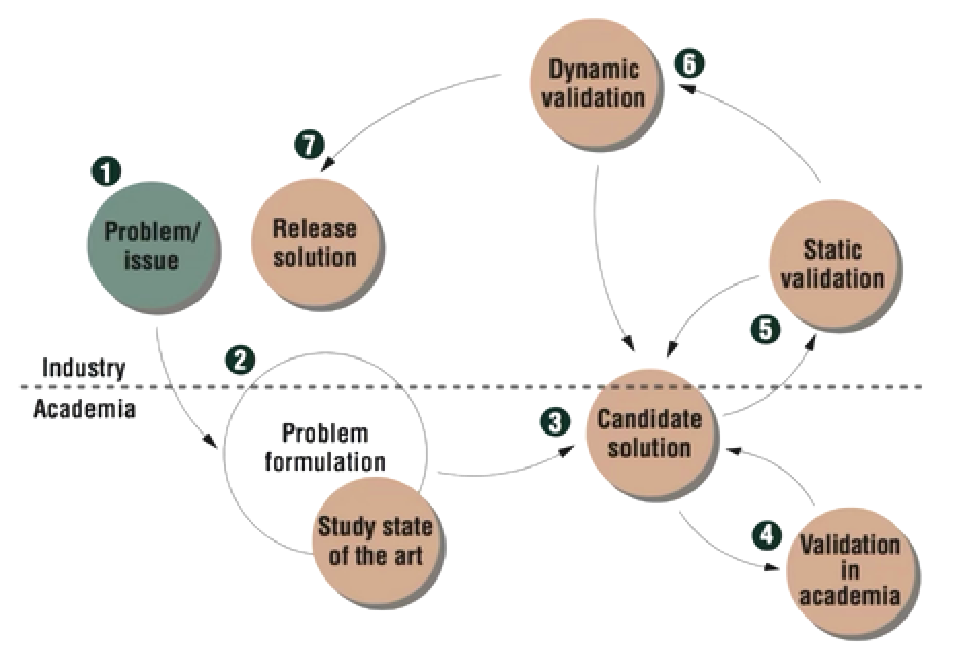
There are no “basic” or “applied” researchers—only research in different states.
We move between fundamental scientific inquiry and real-world application depending on the research question, the technological opportunity, and the societal or industrial challenge.
Our work therefore combines empirical investigation, Artificial Intelligence, Software Engineering, and interdisciplinary collaboration to develop technologies that can move from scientific foundations toward practical deployment.
Our research has been supported by competitive funding from organizations including the Swiss National Science Foundation (SNSF), Innosuisse, Hasler Foundation, and the European Commission, as well as European strategic initiatives.
Research Impact
Our research community has produced 110+ scientific publications in international journals and conferences and has accumulated approximately 8,000 Google Scholar citations, with an h-index of 50.
The lab’s research activities have contributed to more than CHF 3.5 million in competitive research funding as Principal Investigator or Co-Principal Investigator.
Our research has received international recognition through Best Paper Awards, Most Influential Paper Awards, Distinguished Reviewer Awards, and other scientific distinctions.
The research of our group has also been recognized through international rankings and impact assessments, including recognition among the Top-20 Most Impactful Software Engineering Researchers Worldwide, the Stanford University Top 2% Scientists, and ScholarGPS’ top 0.5% of scholars worldwide.
Collaboration
Research in Action
Our research is conducted in collaboration with universities, research institutes, technology companies, industrial organizations, and interdisciplinary partners.
Current and recent research activities span areas including:
- Generative AI and Large Language Models for Software Engineering
- Trustworthy and Responsible AI
- AI-assisted software development
- AI agents and intelligent software systems
- Testing and verification of autonomous systems
- UAVs and autonomous vehicles
- Robotics and intelligent mobility
- MLOps and AI engineering
- DevOps for Cyber-Physical Systems
- Cloud and large-scale software infrastructures
- AI and software engineering for healthcare and life sciences
- Data-driven engineering and empirical software research
Selected projects include InnoGuard, SwarmOps, Safe-2-Fly, BioAI4LCMS, Aerialist, COSMOS, and ARIES.
Research Interests
My research interests lie at the intersection of Artificial Intelligence, Software Engineering, and Cyber-Physical Systems, with a particular focus on the engineering of intelligent, adaptive, trustworthy, and large-scale software systems. Through the Intelligent Development and Large-Scale Systems (IDeaLS) Lab, my research addresses the foundations, methods, and technologies needed to develop, assure, and operate AI-enabled systems that interact with complex environments and increasingly autonomous physical processes.
A central goal of my research is to understand how intelligent systems can be engineered to be not only capable, but also reliable, safe, adaptive, explainable, and trustworthy throughout their lifecycle. This requires bringing together Artificial Intelligence and Machine Learning with Software Engineering, empirical methods, testing and verification, software analytics, and the engineering of complex cyber-physical systems.
My research interests include:
- Intelligent Software Engineering, investigating how AI, Machine Learning, Generative AI, and Large Language Models can transform software development, maintenance, testing, debugging, program comprehension, and software quality assurance.
- Trustworthy and Safe AI, focusing on the reliability, robustness, uncertainty, safety, explainability, and verification of AI-enabled and autonomous systems.
- Engineering Autonomous Cyber-Physical Systems, including autonomous vehicles, unmanned aerial vehicles, robotics, and other systems combining intelligent software, physical environments, sensors, and human interaction.
- AI-Driven Software Testing and Verification, including simulation-based testing, search-based testing, fuzzing, scenario generation, formal verification, and intelligent approaches for assuring autonomous and safety-critical systems.
- Adaptive and Self-Evolving Software Systems, exploring how intelligent systems can continuously learn, adapt, and evolve in response to changing environments, requirements, data, and operational conditions.
- Large-Scale Intelligent Systems, addressing the engineering challenges associated with complex, distributed, data-intensive, and AI-enabled software systems operating at scale.
- DevOps and MLOps for AI and Cyber-Physical Systems, investigating continuous development, testing, deployment, monitoring, and evolution of intelligent systems across their lifecycle.
- AI, Data Science, and Software Analytics, using empirical evidence, large-scale software repositories, behavioral data, and machine-learning techniques to understand and improve software-intensive systems.
- Human-Centred and Socio-Technical AI, studying the interaction between intelligent systems, developers, users, organizations, and society, with particular attention to human factors, trust, decision-making, and responsible AI adoption.
Across these areas, the IDeaLS Lab aims to bridge AI research, software engineering, and real-world intelligent systems, developing engineering principles and practical technologies for the next generation of trustworthy, adaptive, and autonomous software-intensive systems. A particular emphasis is placed on connecting fundamental research with industrial and societal challenges, ensuring that intelligent systems are not only technically advanced but also dependable, verifiable, deployable, and beneficial in real-world contexts.